This will be my 10 year participating in the annual pilgrimage to the desert for the Burningman festival. For the past 5 years I have been a member of the
Zonotopia crew, working on and off the playa to create large art installations. This year is my great honor to be part of the Zonotopia team again. I am also excited to be contributing my own artistic vision to the project: the Zomphalo!
The Zompalo will be the center piece in one of the chambers of the
quasicrystaline conjunction of Zonotopia and it is a collaboration with Chris Palmer.
 |
| Quasicrystaline Conjunction of Zonotopia 2013 - 3D printed model by Chris Palmer |
INSPIRATION
The Zomphalo is a play on words from the Greek omphalos (ὀμφαλός) and Zonotopia. In Greek, the word omphalos means "navel." According to the ancient Greek mythology, Zeus sent out two eagles to fly across the world to meet at its center, the "navel" of the world. Very similar to the Aztec legend... The Omphalos stone at Delphi is the most important oracle in the ancient world. It resembles a beehive with crisscrossing rows of bee symbols. I have always thought that Zonotopia is a bee hive and I must say that the structure of Zonotopia is similar to the Omphalo.
 |
| Omphalo in Delphi archaeologic museum |
I saw the original omphalo when I visited Delphi years ago, I meditated in the oracles cave and I took a stone that I still have in my altar. I knew then that Delphi was a powerful spiritual place. Xeno, my good friend and host in Greece, explained that Deplhi was the belly button of the world (It was his idea that I take a stone from Delphi.) However, it wasn't until recently that I learned about the bee symbology and relationship to the Omphalos. I learned this from the
sacred path of the bee class with Layne Redmond and Debra Roberts. Layne has done incredible work around bee mythology and frame drumming. She has been an inspiration and a great teacher, although I have not meet her in person.
Layne is getting ready to transition from this life and I continue to be impressed at her strength, stamina and gracefulness. She recorded a beautiful CD
Music from the hive with her frame drum music mixed with the sound of the hive. The CD has an 18 minute track with just the sound of the hive. I will be playing her music at the Zomphalo. I would like to especially dedicate this piece to her and to all the amazing research, documentation and educational work that she has done around bees.
 |
| Honey Bee by Sunny Solwind |
Bees have become a huge part of my life, and I have made a commitment to be a voice for the bees. Bees face many threats including habitat alteration, pesticide use, management practices, and pathogens. One third of U.S. honeybee colonies died or disappeared during the 2012 winter, a 42% increase over the year before. Aside from honey bees, there are over 30,000 species of bees, (5,000 found in the U.S) all of them are experiencing population decline. Globally, up to 100,00 animal species die off each year...
Bees pollinate approximately 75 percent of the fruits, nuts and vegetables grown in the United States, and one out of every four bites of food people take is courtesy of bee pollination. In sum, bee pollination is responsible for more than $15 billion in increased crop value each year.
The zomphalo is an offering of reverence to our beautiful buzzing pollinators, it is an altar, a meditation space, a prayer, a place to bee. Blessed bee!
 |
| Native Australian Bee Hive |
HISTORY
Omphalos stones were said to allow direct communication with the gods. Leicester Holland (1933) has suggested that the stone was hollow to channel intoxicating vapours breathed by the Oracle. Erwin Rohde wrote that the Python at Delphi was an earth spirit, who was conquered by Apollo, and buried under the Omphalos, and that it is a case of one god setting up his temple on the grave of another.
The Omphalos at Delphi came to be identified as the stone which Rhea wrapped in swaddling clothes, pretending it was Zeus. This was to deceive Cronus, his father, who swallowed his children so they could not grow up and depose him as he had deposed his own father, Uranus.
While hiding from his father, Zeus was raised by two sister nymphs. One of them was Melissa, she fed him honey. When Cronus discovered this, he turned her into a worm. After Zeus came into power, he changed her into a queen bee, not being able to change her from an insect form. Melissa is the Greek word for honeybee.
The bee, found in Ancient Near East and Aegean cultures, was believed to be the sacred insect that bridged the natural world to the underworld.
The priestess of the oracle at Delphi were known as the Delphic Bees - The Melissea. The emblem of a bee was placed on Delphic coins in her honor.
 |
| Minoan Bee Goddess, golden plaque, British Museum. Found at Camiros, Rhodes, 7th century BCE. |
Bees have been revered as a special spiritual animal in many cultures, traditions and mythologies beyond the Greek. The Hindu great goddess, Kundalini Shakti, manifests as a queen bee surrounded by a swarm of bees and is called Bhramari Devi. When Shakti awakens in a buzz of energy at the base of our spine we experience ascending consciousness to the crown chakra.
Bhramari means bee in Sanskrit. Bhramari pranayama is a traditional yogic practice derived from the buzzing of bees which vibrates and realigns the entire nervous system, brain and body by buzzing the vocal chords.
It is believed that the sound of the hive is the same frequency of the buzzing that we hear when we are in complete silence or when we do bhrameri. This frequency allows us to open a connection to our spirituality, our higher self. More information on Bhramari and the connection to the sound of the hive at this
workshop by Layne Redmonds.
.jpg) |
| Bee altar with Zomphalo, CNC cut bee and spell jar with honey from my hives |
My idea is to create a sanctuary where one can meditate and allow for that spiritual connection through the buzzing of the hive. A Place to connect with ourselves, with our higher being, our calling.
A Place to bee!
.JPG) |
| Laser cut Zomphalo |
PROCESS
The concept was to create a zomphalo with carvings of the Greek bee goddess and small holes to insert amber-like jewels with bees in them. The bee jewels are my way of honoring the bees and place them in their own special shining place. I also wanted to have enough hidden space at the center of the piece to have a sound system playing the sound of the hive. We wanted it to be easy to assemble using a similar technic to Zonotopia where the wood interlocks and there is no metal used.
Chris created a mock up model with with laser cutter and we liked it so we built a full scale model for the pre- compression event.
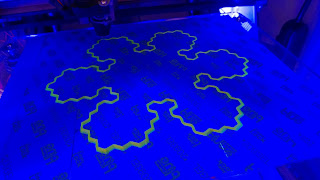 |
| Wozzel being 3D printed |
The full scale model also had 3D printed hexagon honey combs to allow for small viewing spaces into the zomphalo and for the light to shine outwards. Chris also 3D printed the
wozzel (This is a word that he coined for the geometrical hive-like 3D prints) to hold the RGB LED lights. The lights were programed to run from white to red, mostly on the yellow, gold colors to resemble to color of the hive.
 |
| Wozzle |
Here is Chris' description of the Wozzles: "...are made from a 2d polyline that is transformed each small step in the z direction with rotation and scaling controlled by a sine wave function (sometimes sum of sine waves). Sometimes the 2d motif is the same throughout changing only rotation and scale other Wozzles have a dynamic motif that is itself controlled by a sine or cosine wave. Each loop/ polyline is written straight to gcode instructions for the 3d printer by a program so unlike many 3d printed models there is no mesh (made of triangles) model."
 |
| Wozzel honey comb on side panel |
 |
| Top view of Zomphalo with wozzel |
For the jewels I collected dead bees outside of the hive. It was a battle with the wasps and the spiders who are constantly waiting to eat the dead bees. I had to go back to the hive many times to collect enough bees for the project. This was a really beautiful part of the process as I spent a lot of time outside the hive, just listening, smelling, observing and practicing my bhrameri with the bees.
I also used bees from my mother's hive to represent and honor all the bees that have died to pesticides.
 |
| Collecting dead bees outside the hives |
I tried making the jewels with hard candy first, but that did not work so well. The candy got all sticky even after I sprayed it with laquer. I decided to use
entropy resin. It is a bit of a process and it is dangerous if not mixed properly. It needs to be done outside with a mask, gloves, googles and perfectly mixed otherwise it wont harden properly. I also added an amber dye. I used candy molds to pour the mix and placed the bees with wire. The bees kept floating to the top. It might work better if done on two pours but I did not have the time for 2 pours (nor the patience.)
 |
| Ambar-like resin bee jewels |
The resin worked really well. I'm happy with the result.
 |
| Ambar-like resin bee jewels |
The jewels were inserted into the sides of the zomphalo panels and hot glued.
This is the trial build of all the parts before heading out to the playa. The test built work and all the parts fit together perfectly and the tolerances are right. There is space to run all the wiring for the lighting and sound.
The woozel was illuminated and it seems as if the zomphalo was on fire.
.jpeg) |
| RGB LED Illuminated Woosel |
We also did a mock up of the Quasicrystalline Conjunction to make sure that it works and we checked to make sure there is enough space to hold the Zomphalo and for people to walk around it.
 |
| Quasicrystalline Conjunction and Zonotopia s.w.a.g |
It is looking awesome. I can not wait to see it all built.
.jpeg) |
| Zomphalo test build |
.JPG) |
| Zomphalo ideas on trace hanging on my window |
Infinite gratitude to Chris Palmer who has made it possible to manifest my vision into the physical realm with his incredible skills and access to amazing tools (3D printers, laser cutters and CNC routers.)
And to Rob Bell for allowing me to play and express myself in his space. Thank you for believing in me and holding my hand.
I hope that the space we create allows for many experiences to happen. I hope it serves as stage for life. I hope that love is transmitted and radiated. I hope people can find a refuge and an opportunity to bee still and listen. But beyond all, I hope my bee altar brings awareness to the bee Colony Collapse Disorder situation we are faced with and creates a space for people to appreciate, connect and think of actions they can do to
help the bees. Plant a garden, stop using pesticides, be mindful of your food and avoid GMO's.
This Zomphalo is a seed that I'm planting and I am hoping it will become a bee sanctuary, a place for bees to thrive, a place for all bee-ings to connect. A place to bee!
With honey in my heart,
Patricia Humming Bee
Zome Mani Padme Zome


.jpg)
.JPG)


.jpeg)
.jpeg)

.jpeg)
.JPG)


